How Sport Builds Confidence in Children: What the Research Says
A child who believes they can handle a challenge behaves differently from one who does not. They try harder. They recover faster from setbacks. They put their hand up, join in, speak out. Confidence is not a personality trait fixed at birth. It is built, layer by layer, through experience - and sport is one of the most effective environments in which that building happens.
This is not just parental intuition. A growing body of research confirms that children who participate in structured sport develop measurably higher levels of self-esteem, emotional resilience, and social competence than those who do not. The evidence is strong enough that Sport England, the UK's leading body for grassroots sport, now explicitly frames youth sport participation as a wellbeing intervention, not just a health one.
But not all sport participation is equal. A kickabout in the park is wonderful. A structured coaching programme with clear goals, professional instruction, and progressive challenge does something different. Understanding that difference matters if you are making decisions about how your child spends their time - particularly their summers.
What the research tells us
Sport England's Active Lives Children and Young People Survey has tracked youth sport participation and its outcomes for years. The findings are consistent: children who are physically active report higher levels of individual development - a measure that includes self-confidence, resilience, and self-regulation. The relationship holds across age groups, genders, and backgrounds.
The Youth Sport Trust, which works with schools across the UK to develop sport provision, has published similar findings. Their research highlights that sport participation builds what they call "physical literacy" - not just the ability to perform skills, but the confidence and motivation to be active. Children who develop physical literacy are more willing to try unfamiliar activities, more resilient when they fail, and more socially connected to their peers.
International research supports this further. A meta-analysis published in the International Review of Sport and Exercise Psychology found a significant positive relationship between sport participation and self-esteem in children and adolescents. The effect was strongest when the sport environment was structured, supportive, and focused on personal improvement rather than purely on winning.
The common thread across all of this research is that sport gives children a repeatable experience of effort leading to improvement. They try something difficult. They practise. They get better. That cycle - struggle, effort, progress - is the mechanism through which confidence is built.
Why structured coaching matters more than free play
Free play is important. Unstructured time in a park, a garden, or a playground teaches children to negotiate, invent, and entertain themselves. Nobody is arguing against that. But structured coaching does something different, and the research distinguishes clearly between the two.
In free play, children tend to do what they are already comfortable with. The confident child dominates. The less confident one hangs back. There is no external scaffolding to ensure everyone is challenged, included, and progressing. The activity happens, and then it stops. There is no reflection, no feedback loop, no intentional progression.
Structured coaching changes the dynamic. A good coach creates an environment where every child is working at the edge of their ability. The drills are designed to be achievable but challenging. Feedback is specific: not "well done" but "your footwork was quicker that time - did you feel the difference?" Progress is made visible. A child who could not do something on Monday can do it by Thursday, and they know exactly why.
This is where the confidence effect is strongest. When a child can point to a specific skill they have developed through their own effort, something shifts in how they see themselves. They are not just someone who plays football. They are someone who worked at something difficult and got better. That identity - I am someone who can improve - transfers well beyond the pitch.
The social dimension of sport confidence
Confidence is not only about believing in your own ability. It is also about believing you belong in a group, that your contributions matter, and that you can handle social situations. Sport builds this social confidence in ways that are hard to replicate in a classroom.
Team sports require communication, trust, and the ability to manage emotions under pressure. A child learns to celebrate a teammate's success, absorb the frustration of a mistake, and keep going when the score is against them. Individual sports develop a different but equally valuable form of confidence: the ability to stand alone, rely on your own preparation, and perform when all eyes are on you.
In both cases, the social context matters. Training alongside peers, being coached by an adult who is not a parent or a schoolteacher, navigating the informal hierarchies of a sports group - all of this stretches a child's social muscles. Research from the University of Stirling's Children's Physical Activity and Health Research Group found that the social relationships formed through sport were a significant predictor of continued participation and positive wellbeing outcomes.
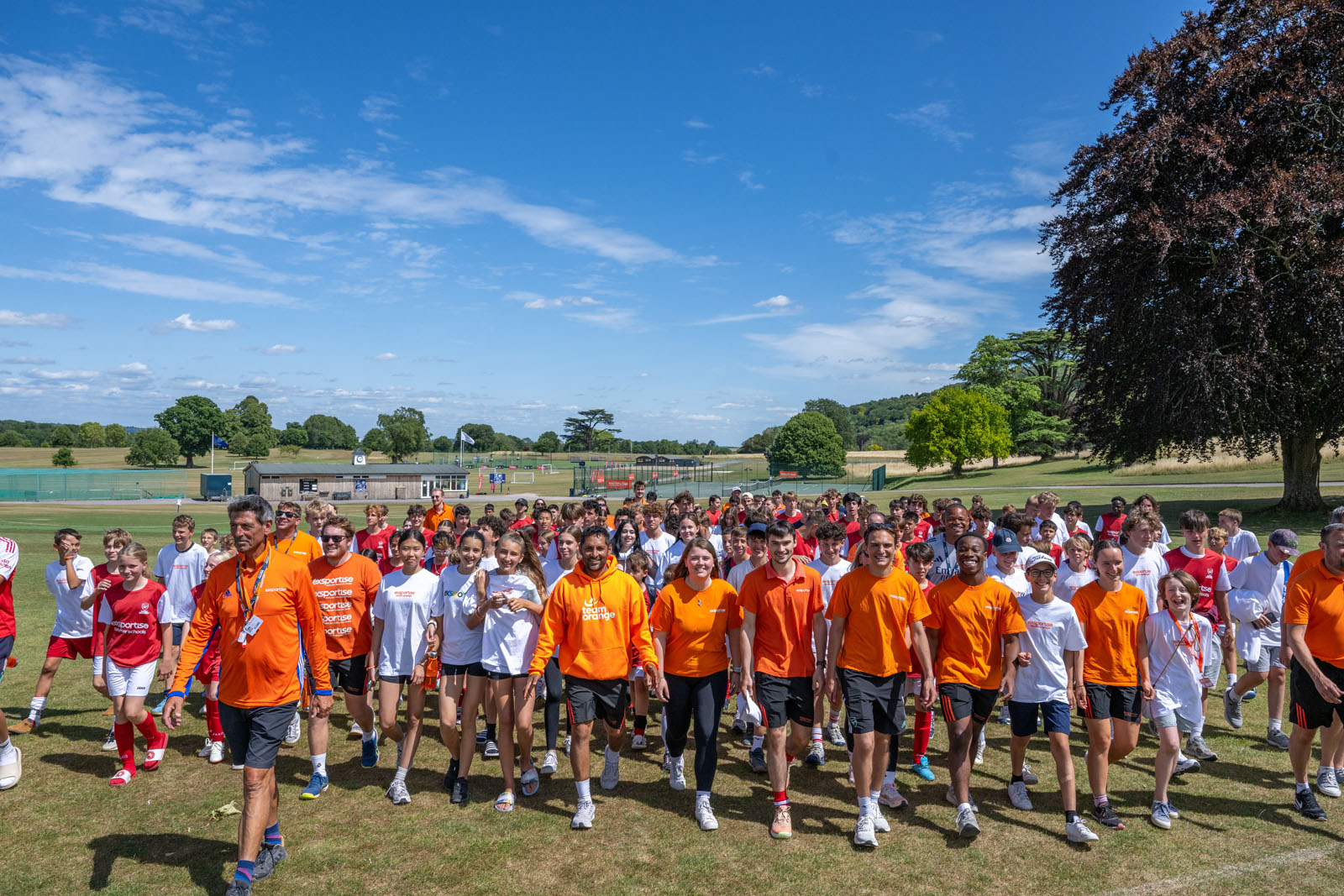
At a residential programme, this social dimension is amplified. Your child is not just training for an hour and going home. They are living alongside their teammates, eating together, socialising in the evening, sharing rooms. The sport becomes the entry point to a much broader social experience, and the confidence built on the pitch spills into every other part of the day.
Resilience: the underrated outcome
Confidence gets the headlines, but resilience might be the more important outcome. Sport teaches children to fail, repeatedly, in a low-risk environment. They miss the shot. They lose the match. They get passed by the player they were trying to mark. And then they come back the next day and try again.
This is not a minor life skill. Research from the American Psychological Association identifies resilience as one of the strongest predictors of long-term wellbeing and achievement. Children who learn early that setbacks are temporary and recoverable carry that belief into school, relationships, and eventually their careers.
The sporting environment is uniquely suited to building this. Failure in sport is immediate, visible, and impersonal. Nobody failed because they are a bad person. They failed because the task was hard and they have not mastered it yet. A good coach frames failure explicitly as part of the process: you miss this shot twenty times before you make it consistently. That reframing - failure as information rather than verdict - is one of the most valuable things structured sport teaches.
How a summer programme creates the right conditions
Knowing that structured sport builds confidence is one thing. Finding an environment that delivers it effectively is another. Not every sports club, school PE lesson, or holiday camp creates the conditions the research identifies as most effective.
The research points to a few critical factors. The coaching needs to be skilled and intentional. The environment needs to be supportive rather than purely competitive. The challenge level needs to match the child's ability. There needs to be sufficient time for genuine improvement to occur. And the social context needs to be positive.
A two or three-week residential programme meets these conditions in ways that a weekly training session often cannot. At Exsportise, children receive three hours of professional coaching every weekday from specialist coaches - not generalist activity leaders. The coaching is progressive, building across the programme so that by the final days, children are working at a level they could not have managed at the start.
The environment is competitive enough to be motivating but structured to ensure every child develops, not just the most talented. Classes and coaching groups are organised by level. Feedback is individual. The 1:4 staff-to-student ratio means no child goes unnoticed.
Combine that with three hours of English lessons per day, a structured evening programme, and the social richness of living alongside students from over 85 countries, and you have an environment where confidence is not just encouraged but systematically built into every part of the day.
Beyond the summer
The confidence children develop through sport at a residential programme does not evaporate when they go home. Parents consistently report that the changes persist. Their child is more willing to try new activities at school. They handle academic setbacks with more composure. They are more socially outgoing. They carry themselves with a self-assurance that was not there before.
This is consistent with the research. The psychological benefits of sport participation are cumulative and transferable. A child who learns to manage performance anxiety on a tennis court is better equipped to manage it in an exam hall. A child who discovers they can improve through sustained effort in football applies that belief to their maths homework. The confidence is not sport-specific. It is a way of approaching the world.
For families weighing up how their child spends the summer, this is worth factoring in. A holiday is rest. A summer programme that combines structured sport with academic tuition and residential independence is an investment in the kind of confidence that shapes how your child approaches everything else.
Finding out more
If you want to understand how sport coaching works within a residential summer programme, and whether it is the right fit for your child, talk to our team. Book a call to discuss the academies on offer, the coaching approach, and what your child can expect from the experience.
You can also browse the full range of sport academies to see what is available for summer 2026.
Related reading:
- What Makes a Great Summer School Coach? Behind the Scenes at Exsportise
- A Day in the Life at an Exsportise Summer School
- 10 Benefits of a Residential English and Sport Summer School